
Aug 12, 2026Technical Insights
Alternative Source Evaluation for 795nm VCSEL Projects
795nm single-mode VCSEL bare die for Rb D1-line atomic-clock and quantum-sensing evaluation, vapor-cell modules, and source comparison.
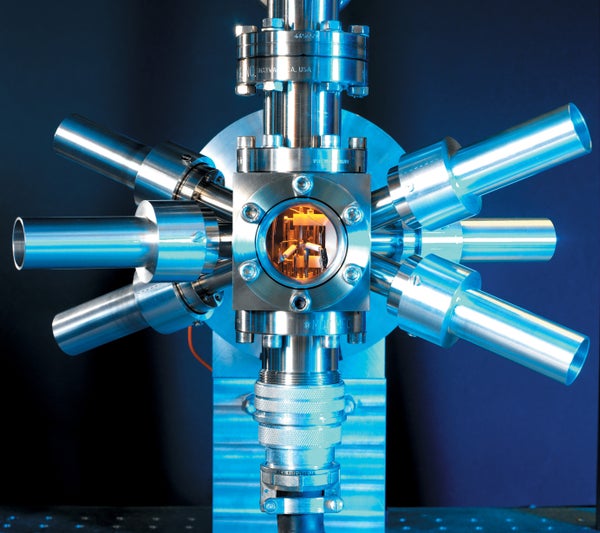
795nm VCSEL for Rubidium Atomic Clock and Quantum Sensing Optical Source Evaluation
795nm single-mode VCSELs are important optical source candidates for rubidium D1-line related systems, including rubidium vapor-cell atomic clocks, CPT atomic clock development, quantum sensing research, magnetometer-related optical pumping, and compact vapor-cell optical modules.
Compared with larger edge-emitting laser structures, VCSEL bare die products offer a compact vertical-emission format, low-current operation, and easier integration into small optical assemblies. For engineering teams developing vapor-cell based systems, the 795nm wavelength range is often evaluated for rubidium D1-line optical pumping and related precision measurement applications.
For this type of project, the laser should not be selected by wavelength alone. Engineers usually need to review the VCSEL together with the vapor cell, drive circuit, temperature control method, optical alignment, detector path, and final package structure. Small changes in operating temperature, current setting, beam shape, or mounting stress may affect the final system response.
Why 795nm Matters for Rubidium-Based Systems
Rubidium atomic clocks and related quantum sensing systems rely on stable interaction between laser light and rubidium vapor cells. In these systems, the optical source must be evaluated together with the vapor cell, temperature control, drive circuit, optics, and detection path.
For 795nm VCSEL evaluation, engineers usually care about more than only the center wavelength. Practical review questions often include:
- Can the wavelength be matched under the actual operating temperature?
- Is the optical output power suitable for the vapor-cell optical path?
- Can the device remain single-mode under the required drive condition?
- Is the linewidth suitable for the intended system architecture?
- Can polarization, beam divergence, and package structure meet the optical layout?
- Can the device be integrated into the customer’s mechanical, thermal, and electrical design?
A suitable VCSEL candidate should therefore be validated at the full system level, not only at the chip parameter level.
Key VCSEL Parameters for Evaluation
For rubidium D1-line optical source projects, the following parameters are usually important during early evaluation:
- Peak wavelength and wavelength tolerance
- Optical output power under defined current and temperature
- Single-mode suppression ratio
- Polarization extinction ratio
- Spectral linewidth
- Beam divergence or field of view
- Temperature-dependent wavelength shift
- Current-dependent wavelength shift
- CW operation stability
- Bare die assembly and wire bonding compatibility
- Package stress and thermal path
- Vapor-cell response under real system conditions
Our 795nm single-mode VCSEL bare die is designed for rubidium D1-line related optical source evaluation. Typical datasheet values include 795nm peak wavelength, 0.13mW optical output power, 30dB minimum single-mode suppression ratio, 15dB minimum polarization extinction ratio, and 100MHz maximum spectral linewidth under Ta = 70±10°C, IF = 1.6mA, DC = 100% test conditions.
From Bare Die Selection to Module-Level Evaluation
Some projects start with a bare die because the customer wants full control over the final optical and mechanical design. This is common in early R&D, custom vapor-cell modules, compact atomic clock development, and specialized quantum sensing systems.
Other projects require more than a bare die. For example, a packaged 795nm VCSEL optical source may need collimated output, a controlled thermal structure, integrated heating resistance, NTC temperature feedback, or low-magnetic / zero-magnetic package design for magnetometer-related systems.
For this type of project, package-level or module-level support can be discussed during engineering review. Depending on the project requirements, possible development directions may include ceramic submount assembly, TEC-assisted temperature control, thermistor feedback, integrated heating resistance, collimated beam output, low-magnetic package material selection, or compact optical module design.
This does not mean every standard 795nm VCSEL bare die includes heater, NTC, collimation, or zero-magnetic packaging. It means the optical source can be reviewed from both chip-level and module-level perspectives when the application requires tighter temperature stability, easier optical alignment, or special magnetic-environment compatibility.
Module-Level Lab Evaluation Data for 795nm VCSEL Sources
Beyond bare die selection, many 795nm VCSEL projects require module-level evaluation before the optical source can be used in a real rubidium vapor-cell system. In our module-level lab evaluation, the 795nm VCSEL source was reviewed with a single-mode VCSEL configuration, zero-magnetic package consideration, collimated laser output, integrated heating resistance, and NTC temperature feedback.
Two temperature configurations were evaluated for different system requirements. Configuration A was designed for a 60°C to 80°C operating window, with electrical-optical characteristics referenced at Tc = 70°C. Configuration B was designed for a 40°C to 60°C operating window, with electrical-optical characteristics referenced at Tc = 50°C.
Module-Level Evaluation Item | Configuration A | Configuration B |
|---|---|---|
Operating temperature window | 60°C to 80°C | 40°C to 60°C |
Electrical-optical reference temperature | Tc = 70°C | Tc = 50°C |
Test current condition | IF = 2mA, CW | IF = 2mA, CW |
Typical peak wavelength | 795nm | 795nm |
Wavelength range | 794.5–795.5nm | 794.5–795.5nm |
Typical laser power | 0.7mW | 0.7mW |
Typical operating voltage | 1.9V | 1.9V |
Typical threshold current | 0.4mA | 0.4mA |
SMSR | ≥35dB | ≥35dB |
PER | ≥20dB | ≥20dB |
Spectral linewidth | ≤30MHz | ≤30MHz |
Typical slope efficiency | 0.40W/A | 0.40W/A |
D86 beam divergence | ≤1° | ≤1° |
Near-field beam diameter, D86 | 2.0mm typ., 3.0mm max. | 2.0mm typ., 3.0mm max. |
Heater resistance | 50Ω typ. | 50Ω typ. |
NTC resistance at 25°C | 10kΩ typ. | 10kΩ typ. |
NTC B value | 3950K typ. | 3950K typ. |
This type of data is useful because 795nm VCSEL selection for atomic clock, magnetometer, or atomic gyroscope projects is not only a chip-level question. The final optical source may need a defined temperature window, stable wavelength behavior, collimated beam output, low-magnetic package materials, heater control, NTC feedback, and a practical electrical interface.
In module-level designs, integrated heater resistance and NTC feedback can help engineers evaluate temperature-dependent wavelength matching. If tighter temperature control or wider system-level thermal stabilization is required, TEC-assisted package or module development can also be discussed during the engineering review stage.
For magnetometer-related or atomic gyroscope-related applications, the zero-magnetic package direction is especially important. Magnetic material selection, package structure, bonding layout, and electrical pin configuration should be reviewed together with the optical path and vapor-cell response.
These module-level evaluation results do not mean that every standard 795nm VCSEL bare die includes heater, NTC, collimation, or zero-magnetic packaging. They show that the 795nm optical source can be reviewed at both bare die level and module level, depending on whether the customer needs chip evaluation, package integration, or a more complete optical source assembly.
Alternative Source Evaluation for 795nm VCSEL Projects
Some engineering teams may also be evaluating alternative source candidates for 795nm single-mode VCSEL products previously used in atomic clock or magnetometer-related optical pumping projects, including devices such as Vixar / OSRAM V00145.
In this case, the evaluation should not be based on wavelength alone. A replacement-source review should compare peak wavelength, operating temperature group, optical output power, SMSR, PER, spectral linewidth, beam divergence, current drive condition, die size, bonding layout, package structure, thermal control method, and final vapor-cell system response.
Our 795nm single-mode VCSEL bare die can be reviewed as an engineering evaluation candidate for rubidium D1-line optical source projects. Final suitability should be validated under the customer’s actual optical, thermal, electrical, and packaging conditions.
Atomic Clock and Quantum Sensing Use Cases
A 795nm VCSEL optical source may be evaluated in several rubidium-related directions:
- Rubidium vapor-cell optical pumping
- Rb D1-line atomic clock evaluation
- CPT rubidium atomic clock development
- Quantum sensing optical source evaluation
- Magnetometer-related optical pumping
- Atomic gyroscope-related optical source evaluation
- Laboratory optical source testing
- OEM integration for compact vapor-cell optical modules
The final configuration depends on the system. A laboratory test setup may only need a bare die or simple submount assembly. A compact OEM module may require controlled temperature, optical collimation, mechanical alignment, and a defined electrical interface. A magnetometer-related project may also place stronger requirements on magnetic material selection and package design.
What Should Be Validated Before Project Adoption
Before adopting a 795nm VCSEL in a rubidium atomic clock or quantum sensing design, we recommend validating the device in the real system environment.
Important validation items usually include wavelength matching at the actual operating temperature, optical power through the vapor cell, linewidth behavior, polarization behavior, modulation or current-tuning response, thermal stability, beam alignment, ESD protection, and long-term operating stability.
For bare die projects, assembly process control is also important. Wire bonding, die attach material, package stress, and thermal path can influence optical and polarization behavior. For packaged or module-level projects, the heater, NTC, TEC, collimation lens, package material, and electrical interface should be reviewed together with the optical design.
Product Entry
For product-level details, please review our 795nm single-mode VCSEL bare die product page:
For custom wavelength binning, package-level integration, TEC-related support, zero-magnetic package requirements, collimated optical output, or compact module development, please submit your project requirements here:
You can also contact us directly for sample evaluation, datasheet review, or engineering discussion: